

Where ancient alleys and rationalist buildings live in harmony.

The area stretching westbound from Via Indipendenza to Via Emilia stands out for the coexistence of centuries-old roads and twentieth-century rationalist urbanization, with palaces built during two decades of Fascist rule in the context of Bologna’s old town medieval architectural landscape. Via Indipendenza itself is quite recent, considering that this straight traffic artery was built around 1890 to connect the railway station directly to Piazza Maggiore, thus becoming the city lounge that introduced Bologna to travellers and tourists. Before then, the parallel Via Galliera was the strolling street where noblemen and wealthy individuals crossed path, in the stately buildings that well-to-do families commissioned to the most prominent architects of the time. Numerous buildings of great artistic value overlook Via Galliera, to bear witness to the taste of the period in which they were built, such as, for example, Palazzo Felicini, which dates back to 1497 or Palazzo Aldrovandi, which was built in 1725. Nestled between these two buildings, on the same side of the road, stands the Basilica of Santa Maria Maggiore, the city’s oldest church built in the 6th century in honour of the Virgin Mary, back when Via Galliera was the so-called cardo maximus (main or central north–south-oriented street) of ancient Roman urban planning. Going up Via Galliera, to the left, in the direction of the city centre, we come across Via Manzoni, and its fifteenthcentury Palazzo Ghisilardi-Fava at building number 4, home to the Medieval Civic Museum. The institution houses many works of art dating between the seventh and fifteenth century; it is a very valuable collection that focuses upon the period in which Bologna political, economic and artistic prowess was at its zenith, stretching all the way into the late 1500s, as embodied by the Giambologna’s (Jean De Boulogne) Neptune, used for the construction of the fountain of nearby Piazza del Nettuno.
 The wooden statue of Boniface VIII covered in golden copper, made in 1300 by Manno di Bandino, stands out from many works on display. Goldsmith art of the Lombard period and glass or ivory works guide visitors through centuries, leading them to evidence of the court life of the Bentivoglio family. Palazzo Fava also includes Palazzo delle Esposizioni, an area dedicated to hosting exhibitions from public and private collections. The building’s rooms are a permanent work of art, with the great cycle of frescoes by Agostino, Annibale and Ludovico Carracci, whose eighteen panels narrate the myth of Jason and Medea.
The work was commissioned to the Carraccis by Filippo Fava in 1584, and is considered one of the masterpieces of Renaissance painting. Opposite Palazzo Fava are the church of Santa Maria di Galliera and the former Oratory of San Filippo Neri. The church dates back to the fourteenth century and, over time, has been enhanced by a sandstone facade adorned with statuesand by the frescoes and paintings by Francesco Albani, Guercino, Giuseppe Marchesi and other artists.
The former Oratory of San Filippo Neri was designed by Alfonso Torreggiani (1682-1764) and houses sculptures by Angelo Pio and paintings by Francesco Monti, two artists who well interpreted the spirit of Bologna’s late Baroque period. It also houses the relocated fresco Ecce Homo by Ludovico Carracci and the organ reconstructed to replace the one destroyed by WWII bombardments. On Via Galliera still, in front of via Manzoni, we reach Via Parigi, where building #5 houses the Oratory of San Colombano. It was built at the end of the 16th century to house the Madonna dell'Orazione by Lippo di Dalmasio (1360-1410).
The building is part of a complex of structures built over centuries around the original nucleus, which is the Church of San Colombano, commissioned in 610 by Bishop Peter I, disciple of Irish monk Columbanus, founder of the monastery of Bobbio. The complex has been recently restored, and the works have brought to light a crypt dating back to the late Romanesque period and a 13th century mural painting depicting Christ on a cross between the Virgin and Saint John. The small church that houses the fresco by Lippo di Dalmasio is particular for the vault decorated at the end of the 18th century by Flaminio Innocenzo Minozzi, a local painter of quadratures (illusionistic painting) and for the Bologna late Renaissance frescoes by Lionello Spada, Lorenzo Garbieri and Lucio Massari.
 On the upper floor, we can admire the congregational hall, richly decorated with works by Bolognese painters of the Carracci school, protagonists of the famous Gloriosa Gara: a cycle of frescoes inspired by the Passion and the Triumph of Christ. San Colombano also hosts the collection of antique musical instruments donated by Luigi Ferdinando Tagliavini and the music library donated by the heirs of Maestro Oscar Mischiati. A few metres down Via Parigi, we reach Via Montegrappa, where at no. 15 there is the church of Santi Gregorio e Siro, built in 1532, which houses precious paintings by the Bolognese school by Annibale and Ludovico Carracci, Camillo Procaccini and Denijs Calvaert, a Dutch and naturalized Bolognese artist. The church stands at the
corner of Via Nazario Sauro, where the Library of Art and History is located in the former church of San Giorgio in Poggiale, at no. 22: this ancient building houses some contemporary works of art by Claudio Parmiggiani and Piero Pizzi Cannella.
 The union between ancient and modern finds space on nearby Via Marconi, a street born in 1936 (after navigable canals were covered) with the name of Via Roma, made of modernist architecture with a neoclassical flair, such as Palazzo Lancia, at the corner with Via Riva Reno, designed by Paolo Graziani with monumental and metaphysical inspiration. Right in front of Palazzo Lancia, on Via Riva Reno no. 57 is the Gallery of Modern Art, Raccolta Lercaro Collection, a free-admission exhibition which puts on display works, among others, by Giacomo Balla and Giorgio Morandi. Another corner building that incorporates the rationalist style of the period is Palazzo del Gas, almost a cusp between Via Marconi and Via Lame, designed by Alberto Legnani.
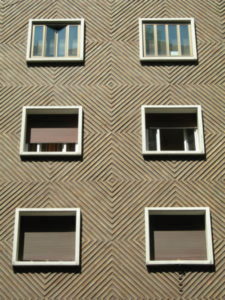
A strong reference to the period is found in Palazzo Faccetta Nera, by Francesco Santini, with its dark front, linear windows and decorative relief motif with concentric diamonds, unique up to that moment. Going up Via Marconi, we cross Via San Felice, to return to classical art with the Church of Santa Maria della Carità, at no. 64. Rebuilt in 1583 and enlarged a century later, it houses works by Bolognese painters from the 16th to the 18th century, including Giovanni Luigi Valesio, Annibale Carracci, Carlo Cignani, Marcantonio Franceschini, Luigi Crespi and others. Not too far away is Via Calari, with its Oratory of San Rocco, at building no. 4: the interior features a precious cycle of frescoes by Carracci’s pupils from 1618, which show the life of the saint in eleven frescoes on the walls. The coffered ceiling with its extraordinary illusory effect of perspective is spectacular.
The Oratory of San Rocco overlooks Via del Pratello, which we can cross in its entirety in just a few minutes, until we find Piazza San Francesco on the right, which is overlooked by the Basilica of San Francesco, impressive from the outside, for the grandeur of its front and its Gothic style. Next to the square, is the courtyard of the Basilica, with its Chiostro dei Morti (Cloister of the Dead), some tombs of thirteenth-century glossators, masters of the Bolognese Studium that created modern jurisprudence on the renewal of Roman Law. Among others, we can see the tombs of Accursio, Odofredo and Rolandino Romanzi. On the opposite side of the Cloister is the entrance to the Basilica, the oldest one dedicated to Saint Francis after the one in Assisi. Built in 1236, it is the first example in Italy of French Gothic style, as testified by its external apsidal arches, even if the forms are still anchored to Roman Gothic style, which is well represented in the facade.
 The great bell tower dates back to 1397 and was designed by Antonio di Vincenzo. The very suggestive interior is shaped like a Latin cross with three naves and the central one, taller, has vaults in six segments like in the Notre-Dame Cathedral. There are nine chapels and an exquisite high altar with a precious marble altarpiece, the work of brothers Jacobello and Pier Paolo dalle Masegne (1388- 1392); of particular interest is the Chapel of S. Bernardino, from the 13th century, decorated with terracotta and the terracotta tomb of the anti-Pope Alexander V built by Niccolò Lamberti in 1424.
The library of the Convent annexed to the Basilica includes over 35,000 works and also included the precious musical collection of composer Father Giovanni Battista Martini, now transferred to the music conservatory in Piazza Rossini. Returning to the back of the basilica and going back a few steps to Piazza Malpighi, visitors reach the corner with Via Sant’Isaia where, at no. 35, they can find the Orthodox Church of Saint Basil the Great in the former church of Saint Anne, founded in 1435 by Cardinal Niccolò Albergati. Inside there are works of art from the Eastern Orthodox tradition together with elements of Western Baroque art, in a unique and evocative mix.
TO SEE
• Museo Civico Medievale Medieval Civic Museum
• Church of Santa Maria di Galliera and its sandstone facade
• Oratory of San Colombano
• Rationalist architecture of Via Marconi
NOT TO BE MISSED
• Carracci’s fresco cycle at Palazzo delle Esposizioni
• Frescoes on the upper floor of San Colombano
• Coffered ceiling of the Oratory of San Rocco
• Basilica of San Francesco
© Copyright 2013 all rights reserved - Bologna ancient and modern - It may not be reproduced in whole or in part.


